Showing posts with label self-awareness. Show all posts
Friday, March 16, 2012
Can You Handle It?
It's a Saturday morning. I'm sitting in my Wonder Woman underwear and t-shirt with a bowl of cereal, watching the Smurfs. A commercial comes on. My 6-year old self instantly recognizes what they're hawking. Dolls. Dolls that grow in a cabbage patch. Plastic heads, yarn hair, squishy body, Xavier Robert's name tattooed on their little booties. I needed one immediately. Since my birthday had already passed, it was time to pray to Santa. Fast-forward to Christmas and guess what I got? A Cabbage Patch doll...knock-off. No tattoo meant it wasn't legit and my baby's bottom was bare as a baby's bottom. What was this feeling again?
Oh yeah. Disappointment.
Although I'd had plenty of experience with this emotion before (no dessert, strictly enforced bedtime, becoming a big sister), it felt brand new. I considered having a tantrum, but quickly deduced it would not get me a real Cabbage Patch doll nor would it enhance the rest of Christmas day. Outside of that, there didn't seem to be any other options in dealing with my disappointment, so I did what any smart kid would do - I played with it until I got distracted by my other new toys.
I wished it stayed that simple.
Whether it be with work, friends, money, baby boos, getting a parking ticket, it often seems like disappointment is lurking around every corner. Some disappointments you get over quickly and move on. My fake Cabbage Patch doll looked real and who was going to look at its butt besides me? If we always got every little thing we wanted, most things wouldn't have much value and would be difficult to appreciate. (Hello, Kim Kardashian wedding.) Unfortunately, as we get older, what our heart desires becomes more complex and multi-faceted.
Disappointment is a part of life and how we handle it can greatly influence how we live. Remember your first heartbreak? Or when you were served with divorce papers? How about when you didn't get that bonus you were promised at work? (That taste in your mouth right now might be bitterness.) While it is easy to fixate on life's disappointments, it can also lead to a life of bitterness and victimhood. These people tend to constantly point their fingers at everyone/something else, seldom taking responsibility for their choices and actions. Life is something that happens to them and to be honest, they are not fun people to be around.
I'm not saying disappointment is an easy emotion to deal with. Often, our disappointments come as a result of expectation. Some believe that having expectations of anything is a set up for disappointment; in some ways, it is. However, if you don't have expectations of anyone, yourself included, what are you striving for? How do you grow? How do you have healthy relationships? There is something to be said about realistic expectations, but to have none is also a set up...just a set up for failure instead.
I believe the hardest disappointments to deal with are the ones you have no control over. Regardless of all the steps you'd taken - the hail Mary's, putting the secret on it, throwing pennies in a fountain, or just plain trying your hardest, you really have no say in the outcome. Unfortunately, that is often the case; there are many things in life we have no control over, but we believe we do. That is the most disappointing realization of them all because there wasn't anything you could have done to prevent your disappointment. But...you can control your response.
When we learn to deal with life's challenges and disappointments in a healthy manner, it can make us a stronger person. It doesn't mean to suppress your feelings; if you need to wallow for a minute, wallow. Nothing wrong with having a little pity party. However, let it reinforce your resolve to keep it pushing, to stay determined and to achieve your goals; your disappointments can either destroy you or inspire you. Whichever path you choose, don't be disappointed by where you end up - it's totally up to you.
And baby dolls shouldn't have tattoos on their butts anyway!
Friday, March 2, 2012
Trickeration in the Dancery
You're at the grocery store and both of you reach for the last organic sprouted gluten-free dairy-free (flavor-free) whatchamacallit. You both chuckle and they allow you to have it...as long as they can get your number. Since they are cute, apparently single and have good taste in whatchamacallits, you give them the digits. Soon thereafter, a date is planned.
Here's the first date checklist:
1. shower
2. shave
3. brush teeth
4. iron your fancy clothes and put them on
5. put on makeup (some guys are into eyeliner)
6. put on some smell-good
7. dust off the heels/church shoes
Some of you know that in your everyday, regular state of being, you barely do 1-3, much less even own an ironing board. However, this is the first date and you only get one time to make a good first impression. While there's the distinct possibility that this whatchamacallit eater may only look good under the fluorescent lighting of a grocery story, you're hopeful that you'll like each other. That's why you're wearing the shoes that cut off the circulation in your left baby toe.
When we date someone new, we all bring our representative. This is the best version of ourselves, the one that not only has wrinkle-free clothing, but also is interesting, delightful, entertaining and totally flaw-free. During the first few dates, our representative is in full effect mode (like Al B. Sure, for your pleasure); we don't want to scare our prospective boos with all our idiosyncrasies and unique personality quirks at one time. If you're fortunate, you've made a real connection and can feel okay to let your soul glow; you can be your truest self and send your representative home.
There's nothing wrong with sending your rep out there; part of it is biological as we are subconsciously drawn to people who are physically attractive for procreating reasons. There is also a list of characteristics to which we respond positively and reinforce our initial physical attraction. But more importantly, we owe it to ourselves to be protective of the information we disclose. In sharing who we are, we make ourselves vulnerable to the possibility of ridicule and judgment. They don't need to know about your bad credit or extensive collection of beanie babies right away. There will be some things they will discover about you (and you them) over time. That's the (allegedly) fun of dating, the getting-to-know someone part.
Some people don't seem to understand there's a difference between a representative and a misrepresentative. Your representative is still you - it's just a more polished version. A misrepresentative, however, is a falsified version of who you are. Sometimes, people outright lie and make up stories about who they are. They often have an ulterior motive (or a personality disorder) for lying, whether it be to get sex, money or whatever. They are the extreme version of misrepresentation. There are others though that may be pretending to be the self they wish they were or the self they think you want them to be. The problem is that your true self will eventually come to light.
To ensure that you're not misrepresenting who you are to your new boo, it's important to take a self-inventory. Get your friends and family involved; they'll be more than happy to tell you alllllllllllllllll about yourself. If you haven't really figured out who you are yet, maybe it's not the right time for you to date. It's also important to know what you want. If you're just trying to get laid, be honest with yourself (and your date) about that. Make sure your behavior is congruent with your words. If you're saying that you don't want a relationship, don't act like you're in one. While some may argue that honesty isn't always the best policy, it is when it comes to being honest with yourself. After all, those beanie babies didn't magically appear in your closet, right?
Friday, December 9, 2011
Wherever You Go, There You Are
I'm sure that quotation was stated by someone very important long ago, but I remember it from the Brady Bunch movie (yes, I saw it, don't judge me). To briefly recap for those of you who allegedly haven't seen it: Mr. Brady often gave fatherly advice that made no sense and left the kids perplexed. This was one of the statements he made and it made me laugh because it was so...duh. However, the more you think about it, it's really quite true - wherever you go, there you are. Essentially, you can never escape yourself.
It's pure genius. (Not evil genius, just regular old genius genius.)
Many of us spend our whole lives trying to do just that. Not necessarily in a conscious and literal "I'm trying to escape myself" kind of way, but more in a "If I could just (fill in the blank), I would be a better person" kind of way. But really, you're still going to be the same person, regardless (disirregardless) of what that thing is. So even if you win the lottery or lose weight or get a better job or have a baby, you're still going to be you. You'll just be a richer, skinnier, better-employed parent version of yourself.
Is that a bad thing? No, not at all. Unless of course, you don't like who you are. Oh wait - is that why you're trying to escape yourself? Then there might be a problem. Fixing what's damaged on the inside cannot come from the outside. Often, what we're seeking is external validation that we're okay. However, it won't ever be enough because the only person whose acceptance you really need is your own. (Kind of sounds like one of those 80s PSAs that are trying to discourage teens from succumbing to peer pressure. Whatever. Honey badger don't care.)
I know I made it sound hella easy and simple. "Just accept yourself and everything will be o-kay." Ha! If it was that easy, who would need therapy? A lot of that self-love and self-acceptance mumbo-jumbo actually starts externally, when we are babies. Our parents are the ones who are supposed to lay down that foundation. Unfortunately, there are lots of parents out there that didn't get the memo and didn't do it. So now as adults, we have to do it for ourselves.
How does one do that? Here is a step-by-step guide on how to accept yourself:
1. Figure out your strengths.
2. Figure out your flaws.
3. Decide if your flaws are all that bad.
4. Surround yourself with people who love you unconditionally.
5. Accept yourself.
See? That's not so bad, right?
Okay, okay, my "guide" wasn't really that helpful, I know. (I accept that about myself, that I didn't write a helpful guide about accepting oneself.) Although you really do have to dig deep within yourself to learn self-acceptance, there are some external factors that can be quite helpful in that journey. Step 4 is very crucial - having a community in which you belong or a support network of friends and/or family is important. If we feel low about ourselves, it can be difficult to identify and acknowledge our strengths and positive characteristics. so sometimes we need outside forces to remind us about what makes us great.
The downside to this self-acceptance journey? It takes time. If you are someone who experienced some kind of trauma during your formative years (i.e. abuse, neglect, abandonment), it can be challenging to undo all those years of negative self-talk; at a certain point it becomes automatic. I encourage you to seek help, whether it be with a therapist or some kind of support group. If you are not happy with who you are, no matter what things you add to your life, nothing will fix that but you. It may take a while, but it's worth it because wherever you go, there you are.
Friday, December 2, 2011
You May Be Right, But Totally Wrong
As people, there are a multitude of things we all do all the time. Besides the obvious autonomic human functions, we eat, we sleep, we talk, we laugh, we brush our teeth...the list goes on and on. Although we do have choices in whether we do these things or not (I'm sure someone has an example of a small Amazonian culture that does not believe in bathing of any kind), most of us do them on autopilot. However, there is one thing on this list that we don't like to admit we do, despite doing it all the time.
I'll give you a hint: we do it everyday. We make big ones, we make small ones. Sometimes it can cause a mess, make a stink.
Hmmm, what could it be?
Okay, I'll tell you.
Judgments.
What did you think I was talking about? Dropping the kids off at the pool? Nah, I know plenty of people who are quite proud of that accomplishment.
Most people would like to believe that they are above judging people. But the truth is, we make judgments about people all the time, every day. We judge what they're wearing, we judge how they act, we judge what they look like. We make judgments about how much money they make or their sexuality. We're constantly judging and more often than not, comparing ourselves. “I would never let myself get that fat,” we think. “I'm always on time, why is s/he always late?”. “That's not how someone should dress if they're trying to look professional, not like a professional.” So on and so forth.
If we're all doing it, why are we so reticent in admitting to it? It's not wrong to make judgments; it's how we learn from others' experiences. The problem lies in what we do with those judgments, namely how we treat others based on how we've interpreted the information. Especially if we're talking about our friends.
How many of us have watched a friend do something totally stupid (in our “humble” opinions)? Or get involved in a situation that had red flags so big you could see them from space? According to my unscientific, self-created statistics, that's basically 99.99999% of the human population. Okay, everyone put your hands down. Now...how many of you saw your friend differently once they were engaged in this stupidity? Okay, a few less people have their hand raised. Lastly, how many of you treated your friends differently? Mmhmm. And what's your friendship like now? I'm gonna go out on a limb and say that it has irrevocably changed....but I'll make no judgment about if it was for the better or the worse.
Our job as a friend is to try to protect our friends from imminent danger, whether it be from a Miami drug cartel (uh, who are you hanging out with?), a crazy Nigerian pyramid scheme or from a broken heart. The operative word is try. We cannot live their lives, nor can we think that we know what's best for them. Although we may feel we can see the whole forest for the trees, we only have the perspective of the outsider. We have no idea what it's like on the inside of the forest; there may be little wood nymphs that make flower wreaths and give amazing foot massages. All we see is a dark, impenetrable and possibly scary-ass forest where we assume lions and tiger and bears live. Although it may seem like we know what's right, we have no idea because we're not in the situation, whatever it may. But I'll bet money that we have been...it's just different because it's our experience, right? #youcandishitbutcanttakeit.
[SIDEBAR] Is it just me, or does it seem like the most judgmental (and quite vocal) people tend to also be the most tight-lipped and sneakative (sneaky + secretive, NW)...ahem, I mean private people? They can talk all day long about what you've got going on, but when it comes to their own skeleton-riddled forest, they are suspiciously quiet.
Anyway...
As being both the judge and the judged, our relationships can be seriously altered when we don't feel like we can trust our friends with all the details. One of the major joys of friendship is feeling unconditionally loved and accepted, regardless of how dirty, stupid, irresponsible and trifling we can be at times. Our friends are not our family – we get to choose them. Even if we disagree with what they are doing, it's also a part of our job to support them anyway (with individually determined boundaries of course) and pick them up when they've fallen down...without the I-told-you-sos preferably. Okay, you can think it, just don't say it out loud.
“The hardest thing to accept is that your friend is an adult and will make decisions that you disagree with. The best thing you can do is love them and be there for them if it doesn't work out, just like you knew it wouldn't.” The best advice given to me by my mother.
Friday, October 21, 2011
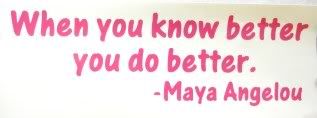
I'm Not Calling Her A Liar...
but Maya Angelou ain't telling the whole truth.
I'm not saying that it doesn't have an ounce of truth to it. It might actually have several ounces. But it's not all the way true. Think about it: we all know it's better to not text and drive, but how many of us still do it? (Does it count if you wait until you get to a red light or stop sign?) Here's what it should really say:
"When you know better, you want to do better. But sometimes you don't choose that and then you feel bad because Beverly already done told you what was better and you're still not doing it."
That feels a bit more accurate, albeit a tad bit wordy.
We all find ourselves in situations on a regular basis in which we know better but don't do better. There seems to be a disconnect between what we know intellectually and how we experience it emotionally. Although most of us would like to think we're rational and intelligent people who can assess a situation and act logically, we often make decisions based on our emotions, wants, needs and circumstances...even the menfolk. Knowledge is power, but many of us "forget" (conveniently) what we know and do it anyway, whatever "it" is.
"It" can be many things, from the seemingly benign (i.e. I know better than to eat 4 mini-Snickers) to more significant situations (i.e. I know better than to sleep with my ex). While we have the necessary information to make a rational and logical choice, we sometimes ignore what we know because it goes against what we want or think we need (I do need Snickers!). Sometimes it also means we're not ready to make changes to our behavior when it comes to some of the situations that require us to make important decisions. For example, eating 4 mini-Snickers may be a small act on its own, but if it's 4 mini-Snickers and you're diabetic, it can have serious consequences.
So why would someone who knows their actions may have real consequences still go through with the action?
Because obviously they're stupid. Just kidding. Change is difficult and people don't change overnight. There are 5 stages to change; many of us stay in the first three stages. Here they are:
1. The Precontemplation Stage - we have not yet acknowledged that there is a problem behavior that needs to be changed.
2. The Contemplation Stage - we acknowledge there is a problem but we are not yet ready or sure we want to make a change.
3. The Preparation/Determination Stage - we're getting ready to change.
4. The Action/Willpower Stage - we're actually changing the behavior.
5. The Maintenance or Relapse Stage - we're either maintaining the new behavior or returning to old behaviors and abandoning the changes we've made.
This model is most often applied to cycle of addiction and recovery, but it works for just about any change in our lives. Here are some common issues that we all struggle with when it comes to making changes:
1. Healthy eating/exercising/weight management
2. Overall health
3. Career
4. Relationships
5. Alcohol/drugs
6. Money
Within all those categories, there are sub-categories and the list can go on and on.
Here's a personal example: Like most people I know, I have struggled with my weight for years. I've done various diets and started (and stopped) going to the gym, only to at some point stop. Part of it was due to thinking I'm a sexy beast regardless of my weight, but I also struggled with a combination of being exercise averse, loving dessert and anything covered with cheese. However, I realized as I got older, it would get harder to lose weight and with several health issues that run through my family, I could easily become a candidate for medication of some sort. So I made a decision to change my diet and exercise routine and for the last 5 years, exercising and some semblance of healthy eating have become a lifestyle. Do I backslide sometimes? Fa sho. There are days I don't want to exercise or eat salad; I want to watch TV while eating junk food. So I do. Just not all the time. I know better than that.
And who can really stop at 4 mini-Snickers anyway?
Friday, October 14, 2011
Can You Hear Me Now? Good.
Recently, a friend (AS) posted a quotation on Facebook:
"The most difficult thing for people to do is hear their own soul." - NDW.
I don't know who NDW is, but they are onto something. Some people may struggle with what exactly constitutes a soul, so for all intents and purposes (intensive purses), I'll just interpret the meaning as being your inner voice, your gut or your instinct with a spiritual twist. For those with a more religious background, it could also refer to God, the Creator or whatever you believe. I digress...
As I look around at the people in my life, many of us are going through huge transitions in our lives. Although life is about constant change, it seems that there are various points in our lives where the changes are monumental. While getting a new job or a different haircut can seem huge (and liberating), I'm speaking to the life-altering events, like changing job industries or having a baby or moving out of the country. Yet how many of us actually embrace those changes? Better yet, how many of us actually listen to our souls when we need to make those changes?
Me neither.
While we may NEED to make those changes, it is frickin' difficult! Little baby changes like redecorating our living space or taking on new responsibilities at our job can quiet what we're trying not to hear, but that only works for so long. So what do we do? We often keep making the little changes in hopes they'll add up to a big enough change that is less uncomfortable - and more importantly, less painful. And boy, does it work.
But does it really?
It depends on what kind of life you choose to live. Many people live an unconscious life, going through the motions and doing everything they should do. They studied engineering in school, so they become an engineer - even though their passion is dance or law. They've been with their partner for eleventy years so now it's time for them to get married - even though they can't stand the way their partner breathes. They buy a house because the market is good and it's (supposedly) better than renting - even though they can't really afford it or hate what they can afford. We ignore our inner voice because what it's telling us sometimes conflicts with what our friends and family (and stankin' ass Beverly) deems appropriate. And if we're people-pleasers, there's no way we want to disappoint them.
How much does that suck? Alotta bit.
See, what happens when we try to shut that loud-ass, f*^king annoying voice up is that it starts showing up in other places and causing trouble. We may start to feel depressed and/or anxious. We may start isolating ourselves because it feels like it's our loved ones who make it feel like change is impossible (or wrong or selfish). Maybe we start breaking out, suffering from insomnia, getting headaches and migraines or some other seemingly random health issue. The one thing that may stand out the most is that no matter how much we tell ourselves that our lives our great and we have everything we should want, we are hardly satisfied and cannot find peace.
Fortunately, there are also a lot of people who do listen to their souls and execute the changes necessary to follow their dreams. They disregard the naysayers and convention and do what feels true to their hearts. While they may struggle at times and question that voice, they know deep down they are doing what was meant for them. We can all think of a bunch of famous people who have done that, but I bet there are people in your circle who have done it too. Maybe it's you who has done it.
Maybe it's me who has done it...finally.
For over the past year, my spiritsoulGodinnervoiceguts have been telling me that I need to go to Paris. I don't particularly know why, but it's been a very loud and obnoxious voice (with a very heavy French accent) that I've been ignoring. I created many reasons for why I couldn't go - no money, not enough time off, I've been there before, I don't want to go alone, blah, blah, blah. But I couldn't tune it out, no matter how hard I tried. I got very still and quiet and just listened. I stopped asking why and asked why not and I bought that plane ticket to Paris. I'm excited and a little bit anxious - it feels like this may be something significant. I could be wrong, but regardless, I'm getting on that plane and for right now, that voice is a little quieter...well, at least on this topic!
Friday, July 8, 2011
To Pass or Not to Pass
As adults, it becomes easier and easier to give ourselves passes because not only do we get more better (yes, I said more better) at rationalizing our behavior, we also no longer get in trouble by mom and dad. We do it in every aspect of our lives: finances, relationships, health, career, children, etc. Some of the things we should do (as much as I hate that word) are really things that we must do but we just don't want to. It may stem from other underlying issues including low self-esteem and fear. Or, in my case above, sheer laziness.
Don't get me wrong, sometimes passes are necessary. It's very easy to go the opposite direction, where we can become so focused on an objective, that it's not good for us. Ever been around someone who's obsessed with their weight/career/love/money? We're not a lot of fun because life requires balance; we become boring and flat if we're only talking about one aspect of our lives all the time. If you're exercising everyday, it's okay to have a piece of cake. If you've been putting in 65 hours a week at work, for the love of all that's holy, take a day off! Not only do we become boring, we become more prone to stress and physical ailments. However, there is a thin line between a genuine inability to do something and the passes we give ourselves because we don't want to do it or deal with it.
Here are some common rationalizations (or passes) to some common issues:
1. "I deserve these shoes because I worked so hard today. That's what the credit card is for."
2. "I'm so tired, I don't think it would be good for me to go to the gym."
3. "I don't have a boo right now, so it's okay for me to still mess around w/my ex."
4. "I should probably go get that bump on my arm checked out, but I'm too busy to go to the doctor."
5. "I know I need to go back to school to get ahead in my career, but it takes too long and it's so expensive."
6. "I've been so hard on myself about my weight; it's not coming off, so I guess I am supposed to be 5'4 and 200lbs. Where's the cake?"
Sound familiar? Yeah, me too.
I'm not saying that every time we make a decision about what we're going to do, whether it be avoiding exercise or buying new shoes, we're giving ourselves a pass. We have every right to change our minds and our paths; that's what free will is about. I fully endorse accepting ourselves for who we are, which includes accepting our limitations. However it's important to be honest with yourself: is this pass deserved or really just another excuse? At the end of the day, we're the most accountable to ourselves.
So...I guess I'll be putting those shoes back. (But I did work really, really hard...kinda. See philosophy stated in the first paragraph.)
Wednesday, April 13, 2011
You Can't Handle the Truth...Right?
Many years ago, a friend and I were discussing something. Probably boyfriends, girlfriends, family; whatever it was, it pertained to relationships. I can't remember the details of our conversation, but the most important thing she said has stuck with me over all this time. I'm about to rock your world. Ready?
“We can't take responsibility for other people's feelings.”
If you feel like time has frozen and everything around you has stopped moving, I'll give you a moment...I completely understand.
…...
…...
…...
You okay now?
I know, it's pretty mind-blowing. What's even mind-blowing-er is that I still can't seem to fully grasp this concept and apply it to my own life and relationships. It's one of those things that me and Beverly are working on – we actually agree this is something I should be doing with a lot more regularity (along with her long laundry list of other things, but I digress).
At first, when my friend was talking about this concept, I didn't really know what she was talking about. After several examples of how we as humans do this (especially women), I finally began to understand what she was saying. It was a revelatory experience; I didn't realize I'd been doing this in most of my adult relationships, both romantic and platonic. In taking responsibility, we're assuming the other person cannot handle any negative emotions and it's our job to protect them. However, in “protecting” them, we tend to cause more harm than good. It's very easy to move from protection to resentment; when we're protecting someone else's feelings, we're often putting our own feelings aside. How rude are we to assume that who we're dealing with cannot handle their own emotions?
Here's the twist; in taking responsibility for someone else's feelings, we get to avoid dealing with our own feelings! We're some real tricksters, aren't we? When we're telling ourselves “I don't want to break their heart, it will devastate them,” what we're really saying is “I don't want to feel bad about myself for hurting their feelings.” We're also avoiding dealing with any potentially negative fall-out from our relationships. We over-empathize with the other person and become fearful of how we will be interpreted. Here are some examples of what I mean:
Situation: You don't want your mom to invite her canasta group to your wedding.
Potential Interpretation: You don't care about her friends and how it will affect her social standing. You don't want to include her in the planning. What she wants is not important to you. You hate her.
Fear: Upsetting/offending your mom, making her angry, looking like a spoiled brat, setting a boundary, owning your feelings.
Situation: Your financially irresponsible friend wants to borrow some money.
Potential Interpretation: You're not a good friend. You don't care about their well-being. You're stingy. You hate them.
Fear: You'll lose their friendship, you'll never see your money again, setting a boundary, owning your feelings.
Situation: You want your mother-in-law to stay at a hotel.
Potential Interpretation: You don't like having her around. She's nosy. She's bossy. You hate her.
Fear: She'll know for sure that you don't like having her around because she's bossy and nosy and you hate her. Just kidding! She'll be upset, you'll offend her, it will upset your relationship, setting a boundary, owning your feelings.
Situation: You want to end a relationship.
Potential Interpretation: You're uncaring, you're mean, you hate them.
Fear: You'll feel bad about hurting someone else, setting a boundary, owning your feelings.
Did you notice a theme in all those situations? Setting boundaries and owning feelings...boy, does it pop up a lot. It's like some kind of mature, adult thing to do that most of us try to avoid doing! It seems less painful to avoid dealing with those situations because they evoke uncomfortable feelings all around. But then that resentment creeps in and infects the relationship because you're doing something you don't want to do; the other person is "making" you. Ironically, once the elephant in the room is addressed, almost everyone feels better...or can at least move through their emotions more fluidly.
Imagine how it could be if we were honest with each other about our feelings? Or more importantly, with ourselves? Wouldn't it be a relief to know that people are actually saying what they mean? Although I continue to struggle with this concept myself, I have seen the value in being honest about my emotions, even the uncomfortable ones, at least in my platonic relationships. If there's an issue, we talk about it, it's over and we move on, friendship still intact, if not stronger. We forget that being honest doesn't mean being tactless. Being honest and preserving the relationship takes some creative genius and sensitivity. But it is possible. Try it and see. Just don't forget the tact!
Do you take responsibility for others' feelings? How has that impacted your relationship? Do you believe honesty is the best policy at all times? Have you experienced someone trying to "protect" you?
Wednesday, March 23, 2011
Shhh, Beverly, Be Quiet!
It may seem a bit scandalous to call out Beverly in a public forum, but I'm getting really tired of her constant commentary. She's judgmental and a bit of a prude; she often discourages me from having any kind of fun and always has something to say about what I'm doing, who I'm doing it with (or to, hehe), where I'm doing it and how it should be done. She inspires anxiety, insecurity and a lot of second-guessing. It feels like we have a toxic relationship and I've considered ending things with her many times.
I can't do it though. No matter how hard I try, I can't shake her.
I'll be honest, I'm painting an unbalanced picture. She's not all bad. She's helped me make some really good decisions, like cutting my hair, moving to New York, pursuing a higher education. There have been times that she's kept me out of trouble by gently suggesting that maybe I don't need to have that 4th drink (although she was nowhere to be found last Wednesday). All it takes is one raised eyebrow and that short skirt goes right back on the rack because we both know I'm not 16 anymore. Beverly can be helpful...when she feels like it.
Unfortunately, she doesn't feel like it much. She whispers in my ear about all the things I should be doing. I'm not a big proponent of that word, should. It makes me feel guilty and unaccomplished; there will always be things on my “should” list that can easily overshadow the items on my “achieved” list. Beverly likes to highlight the shoulds all the time – I should eat better, I should buy a house, I should be settling down, blah, blah, blah. With friends like her, who needs enemies?
That's just it. Beverly isn't my friend, she is a figment of my imagination – but not in a “I'm hearing voices” or “Look at my unicorn” kind of way. She is a named representation of my Superego (I like to refer to her as an internal traffic cop). The Superego is what we use to determine what's right and wrong; it's our conscience or moral compass. While we all have a Superego (at least according to Freud's theory of personality development), it sometimes feels like mine is in hyper drive. Beverly can get in the way of having a good time because there is so much concern about following the rules. "Don't be a slacker, don't waste your money, don't eat that, don't sleep with that person until 90 days have passed, stop, you're enjoying life too much!" What a buzz kill!
Although I believe it's important to adhere to societal rules and expectations, it can be quite bothersome to be constantly aware of how my behavior/decisions may be perceived by others. Noticed how I said may? Ironically, many of us are so focused on how we are being perceived we don't really have enough energy to think about what others are doing. Basically, no one is watching anyone else because we're too worried about how we look. I'd like a side of self-centered with my narcissism, please, but easy on the self-absorption.
So...I know I can't really get rid of Beverly. Even though she gets on my nerves, she can be helpful. And there's nothing wrong with having goals, as long as we remember to truly live in the present and stop fixating what we should be doing for the future. I think I'm just going to work on getting her to relax a little bit and ease up on shoulding all over me. If not, we might have to fight.
Do you struggle in letting yourself live a little? Are you constantly shoulding all over yourself?Have you noticed that you get in your own way of having valuable live experiences? Do you have real-life friends who are similar to Beverly? Does your Superego have a name, or is that just me?
Subscribe to:
Posts (Atom)