Showing posts with label self-esteem. Show all posts
Friday, March 16, 2012
Can You Handle It?
It's a Saturday morning. I'm sitting in my Wonder Woman underwear and t-shirt with a bowl of cereal, watching the Smurfs. A commercial comes on. My 6-year old self instantly recognizes what they're hawking. Dolls. Dolls that grow in a cabbage patch. Plastic heads, yarn hair, squishy body, Xavier Robert's name tattooed on their little booties. I needed one immediately. Since my birthday had already passed, it was time to pray to Santa. Fast-forward to Christmas and guess what I got? A Cabbage Patch doll...knock-off. No tattoo meant it wasn't legit and my baby's bottom was bare as a baby's bottom. What was this feeling again?
Oh yeah. Disappointment.
Although I'd had plenty of experience with this emotion before (no dessert, strictly enforced bedtime, becoming a big sister), it felt brand new. I considered having a tantrum, but quickly deduced it would not get me a real Cabbage Patch doll nor would it enhance the rest of Christmas day. Outside of that, there didn't seem to be any other options in dealing with my disappointment, so I did what any smart kid would do - I played with it until I got distracted by my other new toys.
I wished it stayed that simple.
Whether it be with work, friends, money, baby boos, getting a parking ticket, it often seems like disappointment is lurking around every corner. Some disappointments you get over quickly and move on. My fake Cabbage Patch doll looked real and who was going to look at its butt besides me? If we always got every little thing we wanted, most things wouldn't have much value and would be difficult to appreciate. (Hello, Kim Kardashian wedding.) Unfortunately, as we get older, what our heart desires becomes more complex and multi-faceted.
Disappointment is a part of life and how we handle it can greatly influence how we live. Remember your first heartbreak? Or when you were served with divorce papers? How about when you didn't get that bonus you were promised at work? (That taste in your mouth right now might be bitterness.) While it is easy to fixate on life's disappointments, it can also lead to a life of bitterness and victimhood. These people tend to constantly point their fingers at everyone/something else, seldom taking responsibility for their choices and actions. Life is something that happens to them and to be honest, they are not fun people to be around.
I'm not saying disappointment is an easy emotion to deal with. Often, our disappointments come as a result of expectation. Some believe that having expectations of anything is a set up for disappointment; in some ways, it is. However, if you don't have expectations of anyone, yourself included, what are you striving for? How do you grow? How do you have healthy relationships? There is something to be said about realistic expectations, but to have none is also a set up...just a set up for failure instead.
I believe the hardest disappointments to deal with are the ones you have no control over. Regardless of all the steps you'd taken - the hail Mary's, putting the secret on it, throwing pennies in a fountain, or just plain trying your hardest, you really have no say in the outcome. Unfortunately, that is often the case; there are many things in life we have no control over, but we believe we do. That is the most disappointing realization of them all because there wasn't anything you could have done to prevent your disappointment. But...you can control your response.
When we learn to deal with life's challenges and disappointments in a healthy manner, it can make us a stronger person. It doesn't mean to suppress your feelings; if you need to wallow for a minute, wallow. Nothing wrong with having a little pity party. However, let it reinforce your resolve to keep it pushing, to stay determined and to achieve your goals; your disappointments can either destroy you or inspire you. Whichever path you choose, don't be disappointed by where you end up - it's totally up to you.
And baby dolls shouldn't have tattoos on their butts anyway!
Friday, December 9, 2011
Wherever You Go, There You Are
I'm sure that quotation was stated by someone very important long ago, but I remember it from the Brady Bunch movie (yes, I saw it, don't judge me). To briefly recap for those of you who allegedly haven't seen it: Mr. Brady often gave fatherly advice that made no sense and left the kids perplexed. This was one of the statements he made and it made me laugh because it was so...duh. However, the more you think about it, it's really quite true - wherever you go, there you are. Essentially, you can never escape yourself.
It's pure genius. (Not evil genius, just regular old genius genius.)
Many of us spend our whole lives trying to do just that. Not necessarily in a conscious and literal "I'm trying to escape myself" kind of way, but more in a "If I could just (fill in the blank), I would be a better person" kind of way. But really, you're still going to be the same person, regardless (disirregardless) of what that thing is. So even if you win the lottery or lose weight or get a better job or have a baby, you're still going to be you. You'll just be a richer, skinnier, better-employed parent version of yourself.
Is that a bad thing? No, not at all. Unless of course, you don't like who you are. Oh wait - is that why you're trying to escape yourself? Then there might be a problem. Fixing what's damaged on the inside cannot come from the outside. Often, what we're seeking is external validation that we're okay. However, it won't ever be enough because the only person whose acceptance you really need is your own. (Kind of sounds like one of those 80s PSAs that are trying to discourage teens from succumbing to peer pressure. Whatever. Honey badger don't care.)
I know I made it sound hella easy and simple. "Just accept yourself and everything will be o-kay." Ha! If it was that easy, who would need therapy? A lot of that self-love and self-acceptance mumbo-jumbo actually starts externally, when we are babies. Our parents are the ones who are supposed to lay down that foundation. Unfortunately, there are lots of parents out there that didn't get the memo and didn't do it. So now as adults, we have to do it for ourselves.
How does one do that? Here is a step-by-step guide on how to accept yourself:
1. Figure out your strengths.
2. Figure out your flaws.
3. Decide if your flaws are all that bad.
4. Surround yourself with people who love you unconditionally.
5. Accept yourself.
See? That's not so bad, right?
Okay, okay, my "guide" wasn't really that helpful, I know. (I accept that about myself, that I didn't write a helpful guide about accepting oneself.) Although you really do have to dig deep within yourself to learn self-acceptance, there are some external factors that can be quite helpful in that journey. Step 4 is very crucial - having a community in which you belong or a support network of friends and/or family is important. If we feel low about ourselves, it can be difficult to identify and acknowledge our strengths and positive characteristics. so sometimes we need outside forces to remind us about what makes us great.
The downside to this self-acceptance journey? It takes time. If you are someone who experienced some kind of trauma during your formative years (i.e. abuse, neglect, abandonment), it can be challenging to undo all those years of negative self-talk; at a certain point it becomes automatic. I encourage you to seek help, whether it be with a therapist or some kind of support group. If you are not happy with who you are, no matter what things you add to your life, nothing will fix that but you. It may take a while, but it's worth it because wherever you go, there you are.
Friday, October 21, 2011
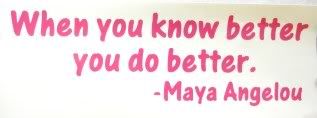
I'm Not Calling Her A Liar...
but Maya Angelou ain't telling the whole truth.
I'm not saying that it doesn't have an ounce of truth to it. It might actually have several ounces. But it's not all the way true. Think about it: we all know it's better to not text and drive, but how many of us still do it? (Does it count if you wait until you get to a red light or stop sign?) Here's what it should really say:
"When you know better, you want to do better. But sometimes you don't choose that and then you feel bad because Beverly already done told you what was better and you're still not doing it."
That feels a bit more accurate, albeit a tad bit wordy.
We all find ourselves in situations on a regular basis in which we know better but don't do better. There seems to be a disconnect between what we know intellectually and how we experience it emotionally. Although most of us would like to think we're rational and intelligent people who can assess a situation and act logically, we often make decisions based on our emotions, wants, needs and circumstances...even the menfolk. Knowledge is power, but many of us "forget" (conveniently) what we know and do it anyway, whatever "it" is.
"It" can be many things, from the seemingly benign (i.e. I know better than to eat 4 mini-Snickers) to more significant situations (i.e. I know better than to sleep with my ex). While we have the necessary information to make a rational and logical choice, we sometimes ignore what we know because it goes against what we want or think we need (I do need Snickers!). Sometimes it also means we're not ready to make changes to our behavior when it comes to some of the situations that require us to make important decisions. For example, eating 4 mini-Snickers may be a small act on its own, but if it's 4 mini-Snickers and you're diabetic, it can have serious consequences.
So why would someone who knows their actions may have real consequences still go through with the action?
Because obviously they're stupid. Just kidding. Change is difficult and people don't change overnight. There are 5 stages to change; many of us stay in the first three stages. Here they are:
1. The Precontemplation Stage - we have not yet acknowledged that there is a problem behavior that needs to be changed.
2. The Contemplation Stage - we acknowledge there is a problem but we are not yet ready or sure we want to make a change.
3. The Preparation/Determination Stage - we're getting ready to change.
4. The Action/Willpower Stage - we're actually changing the behavior.
5. The Maintenance or Relapse Stage - we're either maintaining the new behavior or returning to old behaviors and abandoning the changes we've made.
This model is most often applied to cycle of addiction and recovery, but it works for just about any change in our lives. Here are some common issues that we all struggle with when it comes to making changes:
1. Healthy eating/exercising/weight management
2. Overall health
3. Career
4. Relationships
5. Alcohol/drugs
6. Money
Within all those categories, there are sub-categories and the list can go on and on.
Here's a personal example: Like most people I know, I have struggled with my weight for years. I've done various diets and started (and stopped) going to the gym, only to at some point stop. Part of it was due to thinking I'm a sexy beast regardless of my weight, but I also struggled with a combination of being exercise averse, loving dessert and anything covered with cheese. However, I realized as I got older, it would get harder to lose weight and with several health issues that run through my family, I could easily become a candidate for medication of some sort. So I made a decision to change my diet and exercise routine and for the last 5 years, exercising and some semblance of healthy eating have become a lifestyle. Do I backslide sometimes? Fa sho. There are days I don't want to exercise or eat salad; I want to watch TV while eating junk food. So I do. Just not all the time. I know better than that.
And who can really stop at 4 mini-Snickers anyway?
Wednesday, March 30, 2011
Are They Really Conceited Or Is It You?
There is a huge correlation between one's self-confidence and self-esteem. Our self-esteem is how we feel about ourselves; if we feel good about ourselves, our confidence tends to run high. We believe that we have a lot to offer and that others will want to be around us. As we get older and become more accomplished, our sense of self becomes stronger and we (hopefully) feel more comfortable in our skin. To me, this is the truest definition of having confidence. However, as our confidence grows, it can precipitate jealousy and envy in others, including those we consider to be friends.
Some may argue that the confident person is conceited. Many people have a difficult time understanding the difference between the two. I believe that often, their interpretation has more to do with their own sense of self versus an intellectual deficit. If someone is insecure about themselves, a confident person may make them uncomfortable because it highlights their insecurities. Interestingly enough, I've found that many conceited people actually feel insecure; their arrogance is a way to distract others from seeing their insecurities. Here are the definitions of the two according to thefreedictionary.com:
Confidence: freedom from doubt; belief in yourself and your abilities; "his assurance in his superiority did not make him popular"; "after that failure he lost his confidence"; "she spoke with authority"
Conceited: characteristic of false pride; having an exaggerated sense of self-importance; "a conceited fool"; "an attitude of self-conceited arrogance"; "an egotistical disregard of others"; "so swollen by victory that he was unfit for normal duty"; "growing ever more swollen-headed and arbitrary"; "vain about her clothes"
If you are someone who lacks self-confidence, the world can be a difficult place to navigate. It impacts your career and your relationships; you can miss out on opportunities because you didn't speak up or want to be noticed. It's not something that can change over night, but there are several things you can do to work towards increasing your confidence, including taking an inventory of your strengths, your accomplishments, and learning how to change negative self-talk to positive. (Click on the link if you want more in-depth tips of how to improve your self-esteem and self-confidence.)
Keep in mind, that when we feel good about ourselves, there will be someone out there who wants to rain on our parade. When I was social work intern, I worked at a homeless shelter. I thought I got along well with the staff, both men and women, until I learned that some of the women didn't particularly like me. I was friends with the office manager; one day, when we went to lunch, he shared this little tidbit of information. Here's how the conversation went:
Him: Blah blah and so-and-such don't really like you too much.
Me: Oh really? How come? (perplexed expression on my face)
Him: They say you think you're all that.
Me: Oh. (Shrugging shoulders.) Well, they're right, I do think that. It doesn't mean they can't
be all that too.
Him: (Laughing)
Unfortunately, this kind of situation is not unique. We have to be careful about how our confidence is perceived, particularly in professional settings. We can't appear too confident - as women, as people of color, as being young, or whatever applies to you – because we don't know what kind of stereotypes we're combatting as we interact with co-workers and bosses. There is a delicate dance we have to engage in to make others feel comfortable, especially those in power. We don't want to give anyone a reason to try to sabotage us as we move on up.
It seems like our society negatively interprets confidence as something negative, especially for women. Apparently, when a woman has a lot of confidence, it can be perceived as threatening and intimidating to both men and women. I say boo to that! Did that situation deter me from continuing to be friendly and professional with those women? Nope. How they felt about me was their issue and didn't have anything to do with me. Clearly, they needed to listen to Mary J. Blige – no hateration in this dancery!
Have you ever had an experience when someone tried to undermine your confidence? How do you deal with people who seem conceited? Can you differentiate between confidence and being conceited? Have you had to deal with someone else's insecurities in a professional and/or personal setting?
Subscribe to:
Posts (Atom)